A naturally occurring radioactive gas, radon can affect all kinds of properties. It is colorless and odorless. It is also a serious health hazard. Prolonged exposure to radon can lead to lung cancer and other illnesses. It is actually the second leading cause of lung cancer.
As a construction worker, you should be aware that radon is created by the natural breakdown of elements in the soil. It can be found in water and igneous rock. Radon is a product that is created from radium to uranium. Radium then breaks down into radon.
A lot of new construction is being built using a radon-resistant approach. If a building tests positive for radon, a radon mitigation system can be installed.
Those who work in the construction industry can come into contact with radon in the workplace, so it is important to be attentive. Radon testing can help ensure the safety of the work crew. If there is radon in the area, you should take the proper action to ensure that it is safe to continue working at the job site.
OSHA has radon exposure limits for individuals in the workplace. Those limits are based on a 40-hour workweek and should be monitored and tracked and then properly reported.
While radon is something that you cannot see, it is a serious workplace hazard that requires the attentiveness of the whole team.
If you have concerns about radon, speak with an expert on the matter and make sure you have the proper testing protocols in place. Worker safety is essential in all aspects of the job.
Slips, trips, and falls are among the most threatening hazards that construction workers can face. According to the statistics, about 15 percent of all work-related deaths are from these kinds of incidents. Slips, trips, and falls are expensive to employers as well, costing about $11 billion annually. You need to make sure you know how to prevent a workplace slip, trip, or fall as a construction worker. Here is a closer look.
The 2013 Liberty Mutual Workplace Safety Index reported that falls resulting from slips or trips were the second leading reason for workplace fatalities and injuries. These incidents are just right behind motor vehicle accidents. Slips, trips, and falls are a leading cause of emergency room visits.
Here are some things to keep watch for:
Loose rugs or mats
Walking surfaces that are not level
Poor lighting
Obstructed views
Wires and cables that are not covered
Clutter
Preventing falls and slips
There are several things that you can do to prevent workplace slips, trips, and falls.
Clean up as you go, and don’t leave things lying around
For those working outside, knowing the weather forecast is important. Also, having the proper gear for all seasons is essential to the health and safety of construction workers. But in the winter months, temperatures can be misleading. This is a closer look at how the wind chill index can come into play.
Low temperatures and cold weather should be of enough concern, but when the wind is factored in, it can often feel much colder. Wind gusts of 20 miles per hour can make 10 degrees feel like it is 9 below, so you need to be prepared for what the wind blows your way.
When there is wind present along with the colder temperatures, the National Weather Service will issue wind chill advisories or wind chill warnings. That is to alert individuals of the dangers present while outside in frigid conditions.
Tips for working in frigid conditions:
Stay alert and watch for hazards
Be attentive to coworkers and notice if they are experiencing difficulty
Take breaks regularly, and find a warm place to spend a few minutes
Sometimes it turns cold fast, so make sure you take the time for your body to acclimate to the weather conditions and temperatures
If you have the ability to avoid working in the most extreme conditions, take the day off
Drink warm beverages, such as coffee or hot tea, to help keep your body temperature up
Layer up because wet clothing can harm your body
By making sure you are ready for what the winter weather throws your way, you can reduce the risk of physical harm to yourself or your crew.
Operating heavy machinery, including trucks, should always be approached with great caution and concern for the safety of everyone around you. Nowhere is this more critical than on a construction site. Because job sites feature rough terrain, lots of activity, and little in the way of paved roads, they’re overflowing with unpredictability. Truck drivers need to make safe practices a top priority every day. Read on to learn some helpful safety tips to ensure you do so.
Equip Trucks With Warning Systems
Although it’s impossible for drivers to see 360 degrees around them at all times, there are numerous ways to improve visibility and alert others on the site to their presence. Rear- and side-view mirrors are the most obvious of these, but manufacturers are adding video cameras to newer vehicles to help you see more of your surroundings. If you have an older fleet, there are aftermarket systems available that make it easier to increase awareness of what’s going on around you. Backup warning alerts enhance safety by letting others know when the vehicle is in reverse and the driver may not be able to see directly behind him or her.
Stay Focused at All Times
Driving while distracted is never a good idea, but it can be tragic on the Jobsite. Wearing headphones or using a cell phone while driving creates a potentially dangerous situation in a construction area. This is why truck drivers need to keep their eyes and minds on their jobs at all times. Avoiding distractions inside the cab ensures that you’re more alert and aware when you need to be most.
Inspect Your Trucks Every Day
Many times, unsafe conditions are created by mechanical issues with the vehicles themselves, not operator error. This is why it’s crucial to perform visual inspections of each vehicle in your fleet before each shift. Checking for worn brakes, broken tail lights, frayed wiring, and similar issues mean you can catch them before they have a chance to lead to serious accidents. Any potential problems you discover should be dealt with as quickly as possible.
Invest in Training
Safe drivers are made, not born. If you’re in charge of a job site, you should provide adequate training on all necessary safety protocols and regulations. Safety Tips: If you’re a driver, ask what kind of education programs exist at your employer to keep everyone up to date and aware of their responsibilities.
Create a Temporary Roadway
One of the most important things you can do to ensure safe driving conditions at your site doesn’t even involve being behind the wheel. Using timber mats to create temporary roads for trucks and other heavy equipment makes areas safer. This is because they provide a sturdy, stable platform for machines to cross without worrying about slippery or soft soils creating unpredictable situations.
Safety Tip: Driving safely in the cramped, bustling environment of the average construction site may be more difficult than on the open road, but it’s absolutely imperative. Take these tips to heart, and you can ensure that everyone on the job can go home safely each night.
Learning how to weld can lead you to a fulfilling hobby or long-term career, but is incredibly dangerous when not performed correctly. We created this industry-professionally reviewed guide to provide all the safety basics in one place. Topics covered include:
The main hazards of welding and how they happen
Essential welding safety equipment and PPE
How to keep your workspace safe
OSHA requirements for welders
Essential Tips
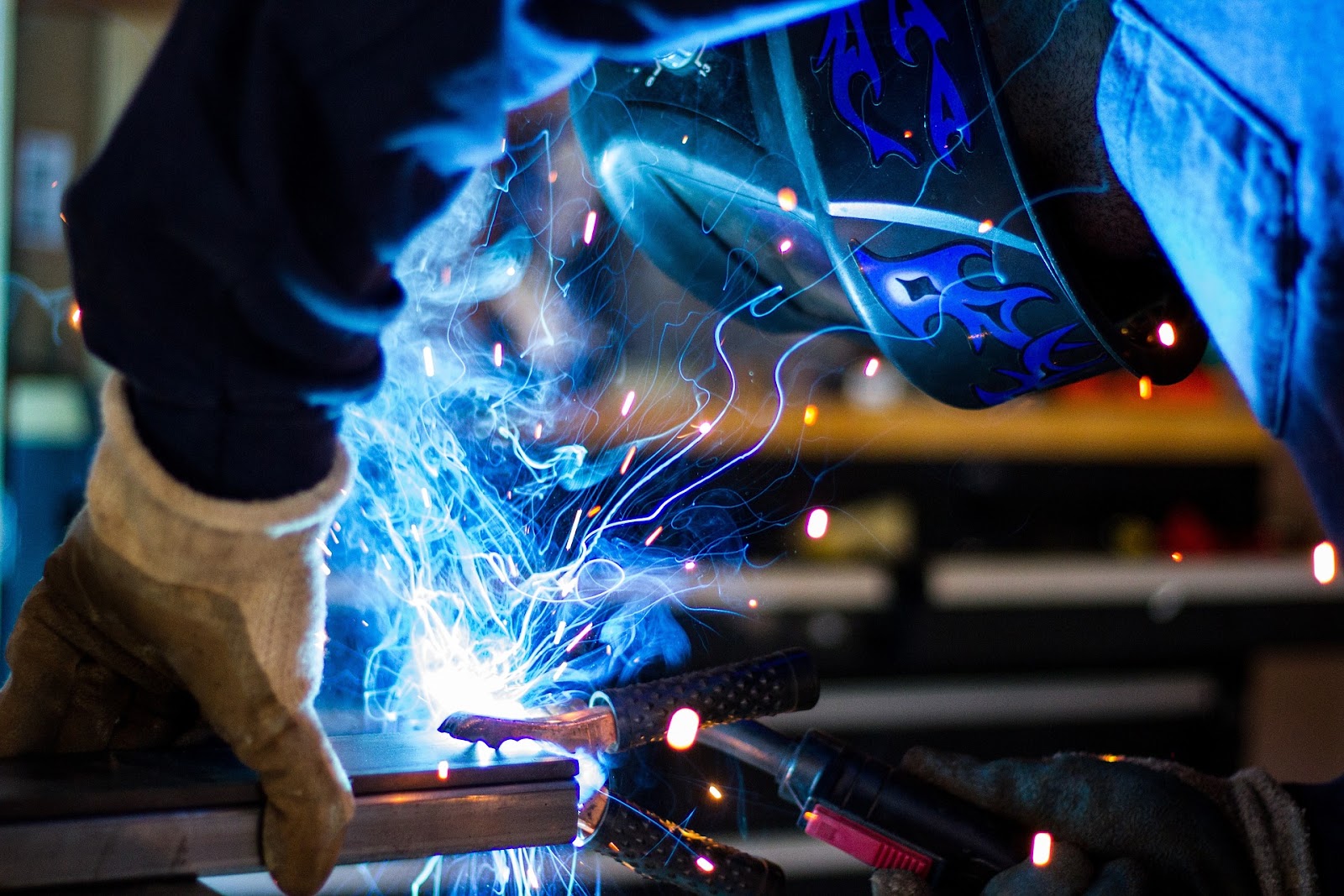
Welding is a craft that has been honed in the last century, it’s a very useful trade to learn, and one that’s in high demand today due to critical construction workforce shortages. It’s a process that involves plenty of dangerous elements — electricity, fire, bright lights, and harmful gas emissions.
Getting burnt, being electrocuted, developing respiratory issues from inhaling hazardous fumes, and being blinded are all very real dangers. Keeping safe is of utmost importance if you value your life, quality of life, or limbs.
Read on for some welding safety tips to keep you safe while you work on your latest welding project.
Protect Yourself
Safety starts with wearing the right gear and protecting your most valuable assets – your eyes, ears, nose, hands, feet, skin, lungs, and limbs, of course. Here is a list of essential items to kit yourself out in:
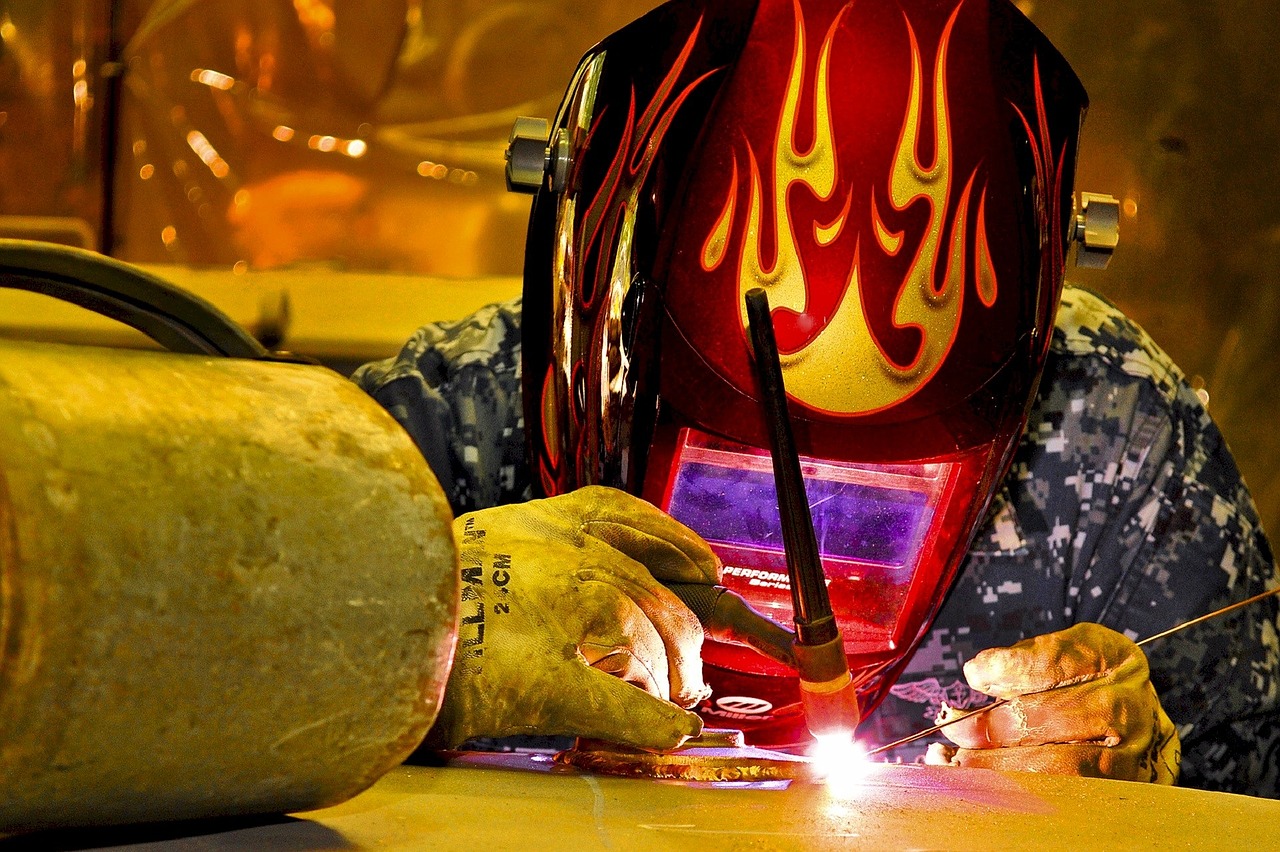
A welders helmet – newer versions now have lenses that adjust to light the same way that prescription sunglasses do so you can see what you are doing when you’re not welding without adjusting your helmet.
Leather boots – make sure to get ones with steel-reinforced toes and a rubber sole.
A heavy overcoat or shirt and apron – leather or fire-retardant canvas or fabric are the ideal materials for these to be made from.
Thick leather gloves, long denim or leather pants, and leather spats – the idea is to cover all of your exposed skin with a flame-resistant material to avoid any nasty burns to your skin from direct spatter or through your clothing catching on fire.
A welding skull cap – will protect your face, neck, and head where your welding helmet does not cover you. It should be flame resistant and cover the top of your head, the side of your face and your ears, your forehead, and the back and front of your neck.
An N95 or N99 mask for simple welding or an N100 mask for arc welding – using one of these while also practicing safe ventilation methods will drastically decrease your exposure to dangerous fumes.
When buying protective clothing, always choose the best quality items you can afford. Inspect each item regularly for damage and replace it if necessary.
Safeguard Your Workspace
Ventilate
Never weld in an area with inadequate airflow. If you are working indoors, make sure you are using a commercial-grade ventilation system or an adequate extraction hood.
Insulate
Make sure you are grounded. Never weld while standing on a wet surface or metal flooring. Wearing the correct gear also helps to insulate you from electric shock and electrocution.
Only allow trained professionals to perform maintenance and repairs on your welding equipment and make sure to test it regularly.
Fire-Proof
Spatter from welders can reach about 35 feet away from where you are working. Clear away any flammable items within this range to avoid starting a fire. If certain things cannot be relocated, cover them with a sheet of metal or a fire-retardant blanket.
You can also block spatter from items within range with non-flammable material.
Hydrate
Dehydration can cause fainting and dizziness. Keep hydrated while you work to stop an otherwise safe situation turning into an unfortunate accident. Plan to take regular cooling-off breaks or take one immediately if you feel dizzy or thirsty.
Prepare for the Unexpected When Welding
Read or re-read the manual before starting work to make sure you understand the operation of all the equipment you will be using.
Apply for a training course to hone your expertise If you’re an employer, consider sending your employees for a training course. There are even employer training grants available in the US for this.
Brush up on emergency protocol. If you don’t yet have a protocol, what are you waiting for? Map out different scenarios and write down what the necessary steps would be. This will help you to eliminate any forgotten hazards and procure any essential emergency, first-aid, and safety equipment that you might have previously overlooked. You’ll be calm and prepared for any situation, and this could save a life.
Keep fire-fighting equipment close by – fire extinguishers that have been inspected and are within their expiry date are a must. A hose pipe, sand buckets, a trough filled with water or wet blanket are also worth considering keeping readily available while you work.
Buy a first aid kit specially assembled for use in welding accidents and get accustomed to using the items in it.
Conclusion
The CDC’s NIOSH Hierarchy of Controls pyramid perfectly sums up the important practices for safety mentioned in this article, listed from most to least effective:
Elimination – physically remove the hazard.
Substitution – replace the hazard with something less hazardous.
Engineering controls – isolate people from the hazard.
Administrative controls – change the way people work around the hazard.
PPE – Protect the worker with personal protective equipment.
While accidents happen in all job roles, more construction workers are injured or killed on the job than those in other professions. According to the Laborers’ Health and Safety Fund of North America, the number of construction deaths on the job in the construction industry increased in 2016 based on Bureau of Labor Statistics data. There were 5,190 fatal on-the-job injuries in the U.S. in 2016, according to the Census of Fatal Occupational Injuries. That figure was a 7 percent increase over 2015. Of those deaths, 970 of them were in the construction industry.
When the figures were looked at more closely, the most common workplace accident that led to death was transportation accidents, which accounted for 40 percent of the fatalities. More workers were killed in transportation accidents than in any other work-related incident.
The second most common fatal event was violence that was caused by other people and/or animals.
Another shocking figure involved overdoses on the job. On-the-job overdoses increased 32 percent from 2015 totals. Fatalities that were tied to overdoses have continued to increase by at least 25 percent per year since 2012.
One of every five workplace death happens in the construction industry. When that is broken down, about 80 construction workers die every month in a workplace accident. When construction accidents were reviewed more closely, the leading cause of death for construction workers is falling. Of the construction workplace fatalities, 379 people died in falls during 2016, which was an increase from 348 in 2015.
While many construction workers interact with tools and heavy equipment on a daily basis, about one-fourth of the laborers killed in the construction industry were killed because of unintentional contact with machinery or equipment, such as cranes, grading machinery, backhoes, front-end loaders, forklifts, and aerial lifts. There were fewer transportation-related deaths in the construction industry, but there were more trench deaths – with the number climbing to 37 in 2016 from the previous year’s 26 deaths.
Construction Worker
Dies After Falling Down Shaft in Florida
According to Miami news stations, a construction worker died after falling down an elevator shaft while working on a building in Hallandale Beach, Florida. According to the news reports, the worker was working inside a large building being constructed in the vicinity of Southeast Third Avenue in Hallandale Beach on Friday, May 3, 2019, when he fell down the elevator shaft. This is why ATS teaches safety training.
According to the authorities who responded to the accident
scene, the construction worker was helping build an addition for the building
when he fell to his death. Police reports indicate that the fall was at least
10 stories. Hallandale Beach Fire and Rescue got help from the Broward County
Sheriff’s Fire Rescue in recovering the body of the construction worker.
Crane Collapse in
Seattle
On April 27, 2019, a construction crane that had been working on an office building for Google in Seattle, Washington, collapsed onto Mercer Street below. Four people were killed, and four others were injured. Many experts believe that the pins or bolts were prematurely loosened or removed from the crane and that made the crane’s vertical mast more vulnerable to the wind pressure that day, allowing the crane to topple. Many experts say the crane collapse was because of human error during the disassembling process.
In this case, it is believed that the workers prematurely
removed the pins that secured sections of the mast to one another, and that
caused the crane to topple. While sometimes workers remove the pins
prematurely, that practice doesn’t coincide with the instructions of the
manufacturer for the crane disassembly process. There is an investigation into
the incident, and five companies that played a role in the construction project
are being reviewed.
The Importance of
Safety at Construction Sites
Construction workers must adhere to safety training guidelines when working on construction sites. Many workers are injured on the job every year, and often, these injuries can be avoided when the proper safety gear is used, and the proper protocol are followed.
As with all aspects of construction work, when digging safely it is important to make sure the whole process is as safe as possible for everyone concerned and to do that we must understand the risks that we take on when digging. Risks from equipment are obvious, and on-site safety procedures take care of that aspect of the dig, but there is another area of risk when digging, and that is that we don’t always know what is underneath us in any location.
Today the country is crisscrossed with underground pipelines, most of them are part of our utility systems, and each presents a danger of its own. From electrical power lines and lighting cables to gas and oil pipes, sewers and drain lines, and even petroleum and gas lines in some situations, all present real danger to operators, those on the site, and the general public should they be damaged.
It is not just danger of course, while the immediate issues of cutting a power line for the operator are clear, there is also the problem for possibly thousands of people it can affect, something else to be avoided too. But, without starting digging, the question is, how do you know what you will find once your digging starts?
The good news is that there is a nationwide initiative to combat this, known as “call before you dig”, in fact, it is a legal requirement to call the service before digging. While a national service, each state runs its own version, accessing it involves dialing a state code plus 811, and you can quickly find the state code for your site online. Contractors should call 2 to 10 days before work starts, giving the location and details. Outline the area of the dig in white paint to show the utility company the affected area. The call center will pass the information to the appropriate utility companies, who will mark lines in that area for you.
Markings follow a standard color code as follows:
Red – Electric power lines, cables, conduit, and lighting cables
Orange – Telecommunication, alarm or signal lines, cables, or conduit
Yellow – Natural gas, oil, steam, petroleum, or other gaseous or flammable material
Green – Sewers and drain lines
Blue – Portable (drinkable) water
Purple – Reclaimed water, irrigation, and slurry lines
White – Proposed excavation limits or route
Once the lines have been marked, you must then confirm with the service that the lines have been accurately located. How you confirm does vary little from state to state, so check with your local center for the exact process.
You can call for a remark should the loss of marking be unavoidable during the project, part of a contractor’s legal requirement is to maintain the marks throughout the project’s life, and with the lines carefully marked, the dig can continue safely, avoiding problems and reducing risks.
“We recently investigated deaths at job sites in Kansas City, Missouri; Framingham, Massachusetts; Brookhaven, Georgia; Bellevue, Washington and Albuquerque, New Mexico,” said Dean McKenzie, the deputy director of OSHA’s directorate for construction. “And that was just one week.”
While this is appalling, the answer is pretty obvious to OSHA. The agency tries to make sure that employers and employees know the safety regulations and follow them so that accidents don’t happen as regularly. But those employers and employees have to be trained, and they have to respect their training. For example, the company doing the demolition of a three-and-a-half-story building in Connecticut had to be stopped before workers were injured:
“It was a brick building built in the early 1900s that they were trying to rehabilitate. The contractor had taken all the interior floor joists that tie the building together so all he had was a brick box,” McKenzie said. “Compliance officers called our engineering office to get our support on how weak this structure would really be and we shut it down until the job could be done safely.”
Imagine the operator of heavy equipment on that job, hoping that the building wouldn’t collapse on top of the work crew. Maybe he even was the guy who called in OSHA when the contractor wouldn’t listen, who knows? What we do know is that the better trained the operators of heavy equipment are, the safer everybody is. There’s a lot of dangerous stuff that happens in construction, and good training keeps it happening safely.
ATS Heavy Equipment Operator Training School works hard to make sure that our graduates are fully aware of the safety regulations and know how to operate their machine to do the job without any injuries. We want you to have a long, profitable career as a heavy equipment operator known for your expertise and safe practices.
Some construction sites that use heavy equipment can be real eye openers if you take the time to look at what is going on and how it affects the community. Often, the construction itself will become a historical item.
Take the Christopher S. Bond Bridge in Kansas City. This bridge, when completed in 2011, will become the first cable-stayed vehicle bridge ever constructed across the Missouri River. Without heavy equipment, that bridge would take another twenty years to complete.
Two barge-mounted heavy cranes were used to lift and position each of the 11-foot-diameter, 85,000-pound steel pipes that line the drill shafts. Once the pipes were in place 48 pieces of 85-foot-long rebar were lifted and positioned inside each pipe. Cranes will also be used to lift each of the 40 cables that will be anchored to the pylon.
Whilst the cranes are busy putting the huge jigsaw puzzle together, bulldozers, graders and loaders are busy preparing the approaches, the on and off ramps along with almost 5 miles of highway that will be reconstructed or rehabilitated.
There are 1100 people working on that project and it has another two years to run – and it is only one of many thousands of projects being worked on around the country right now – with more to come. They will not all be as interesting bridge building – however, if you’re prepared to look a little closer, you will always find something interesting about them.
Heavy equipment could help build roads or bridges without carefully trained operators to control the equipment. You can join the heavy equipment workforce by undertaking a training program that has been accredited by industry – the people who do the hiring the firing. ATS Heavy Equipment Operator Schools are accredited to deliver training and can help you get your career as a heavy equipment operator off to a flying start.