Heavy Equipment

Saftey Training Is Critical

When anyone makes the decision to start out on a new career path, there’s always a bit of apprehension involved at first and that’s why the experts at Associated Training Services realize to become a heavy equipment operator means that the right saftey training is critical.
Dump Trucks
And that means that when when clients sign on here to get the best in dump truck training, they can rest assured that they’ll be ready to join a team as a safe and reliable driver that’s going to be valued by both co workers and management alike. All the courses offered here are designed to give clients the best in hands on and classroom instruction and all the curriculum is recognized by the National Center for Construction Education and Research (NCCER).

As well as the standard dump truck training, the student will also receive instruction in heavy equipment maintenance and site layouts as part of the comprehensive package that ATS offers. The thing is there are jobs waiting as part of the economic stimulus plan that has been unveiled by the federal government, and there is a need for the right heavy equipment operators to fill the bill.

That’s why people looking for a new career are looking to heavy equipment. This is the path that’s offering stability in the face of the economic challenges that are facing the nation and the world, but it’s essential that you get the proper saftey training as well so that you can have the confidence to do the job properly.

Read more

Heavy Equipment Operators Are In Demand

There’s a new aptitude in America and those catching this new wave are the ones that know getting trained to be a heavy equipment operator is the way to go. When you need the best training that’s done by the more knowledgeable staff, you need Associated Training Services.
Backhoe
And there are machines that are helping to rebuild the roads and streets nationwide like the backhoe. There are a variety of reasons that you might want to change jobs or even start a new career and the professionals at ATS are there to guide you every step along the way.

They have all the necessary attributes that will get you started in a new career as a backhoe operator, and for those who are having trouble in these hard economic times they’ve even got the right financing options to help you get a good start.
Reputation
And these are the people that have the reputation that you can trust. This is a family run business that goes back to 1959 and their obvious commitment to quality and excellence has enabled them to get connections within the industry as well as a host of testimonials from satisfied and successful students.

Take a look at what the professionals here at ATS have to offer in the way of training for the backhoe as well as a host of other construction machinery. Heavy equipment operators are in demand nationwide, and this is the place to get the heavy equipment training that you’ll need to get the best jobs.

Read more

Motor Graders Are The Artists In The Heavy Equipment Family

Where bulldozers rely on brute strength to push dirt around, motor graders rely in finesse to finely ‘grade’ as surface. Motor graders truly are the fine artists in the heavy equipment family.

Bulldozers are short stout muscle men. Motor graders are long and narrow. Bulldozers are often sitting on tracks which make them slow and cumbersome. Motor graders are on wheels which make them fast and nimble. The bulldozer has a blade at the front, the motor grader a blade hanging from the middle of the vehicle. I could go on with these comparisons, after all, they are both heavy equipment that has been designed to push dirt around.

The biggest difference is that bulldozers push huge quantities of dirt over short distances. Motor graders make long passes gently taking the top surface and trimming and smoothing it until it has the right angle or the right slope.

Road making is a prime example of a graders work. All roads have a slight angle to them, carefully designed to influence the run off of water. On corners, these angles (or camber as it is known) is designed to keep the car on the right line going around the corner, particularly when going through mountainous or hilly areas.

Believe it or not, the bulldozer can do some of the work that a motor graders does. However it takes far longer and is not precise like a true grader. A grader would have difficulty doing the work of a bulldozer.

If you’re somewhat of an artist and would like to work in the heavy equipment field, then check out ATS Heavy Equipment Training Schools to see if we have the right training program for you.

Read more

Specialized Heavy Equipment – The Bucket Wheel Excavator

There are many different types of equipment that come under the classification of heavy equipment. Some of these machines are specialized and training is generally undertaken on the job. A prerequisite to gaining employment and subsequent training for many companies is some form of heavy equipment training and experience.

One specialized machine that you wont see every day is the bucket-wheel excavator. These machines are used in surface mining and civil engineering. The bucket-wheel gets its name from the design – a large rotating wheel mounted on an arm or boom with a series of scoops or buckets on the outer edge of the wheel. As the wheel turns, the buckets remove soil or rock and carry it around to the backside of the wheel where it falls onto a conveyor.

Some bucket-wheel excavators truly fit the classification of heavy equipment. The can be over 200 meters long and up to 100 meters in height.

The largest machines are used in German strip-mining operations. They cost over $100 million, take 5 years to assemble, require 5 people to operate and weigh more than 13,000 tons. The MAN Takraf is recognised by the Guinness Book of World Records as the largest land vehicle.

Of course they are the giants. There are smaller bucket-wheel excavators in use. To operate on of those machines requires specialized training. This training is based on your knowledge and experience in using excavators or other heavy equipment such as bulldozers or motor graders.

You can receive training in heavy equipment such as bulldozers, motor graders and excavators through ATS Heavy Equipment Training Schools.

Read more

Learning to Run Heavy Equipment: It Ain’t Like It Used To Be (Part Two)

From the “How NOT to do it!” Department:

So after a freezing cold, thirteen hundred mile flight in an ancient DC3, I arrived in Echo Bay in the Northwest Territories, 12 miles south of the Arctic Circle. It was my twenty-fifth birthday, but I wasn’t celebrating. We landed on an ice strip – apparently right in front of the mine, but I couldn’t see anything but white. I have no idea how the pilot landed that thing. Two guys looked out the window and refused to leave the plane.

The rest of us newbies shuffled off the plane and onto a bus that took us up a winding goat trail to the office, where we were given a room, a list of rules, and were told to report to work within the hour. By the time I had put my stuff in one of the worst bunkhouses I’d ever seen, the weather closed in and the plane was grounded. For two days as it turned out.

Through near white-out conditions, I made my way down the 117 steps to the garage. After introductions the consisted of a nod, a grunt and a really bad cup of coffee, the foreman said, “Get on that six and put the blade on it. Push the road to the dump”, then he turned and left. I looked at the ancient mechanic, wondering what a six was. He tilted his head toward a bulldozer at the other end of the shop. A Komatsu D6. AHA…, I get it! Then to myself, “They want me to run that? I thought I was here for a forklift job?”

Then it sunk in…, I had never even sat on a bulldozer before, let alone had any training. I smiled a sickly grin. The old mechanic stared at me and spit on the floor. I smiled wider. He didn’t – he just stood there waiting for me to do something. So I gave him that time-honored line, “Huh! What d’ya know? She’s not quite like the last one I drove!” He rolled his eyes, sighed far too loudly, and pointed to the floorboards – he knew exactly what was going on. He’d probably seen hundreds of guys like me.

Humbled, I asked him where the blade was, and he pointed out into the now raging storm. “bout a hundre’…, up…,” I couldn’t hear him after that because he opened the big doors and walked out in the howling wind. Folks, here’s where I could really have used some training!

But at least I was alone! I climbed on my new “six”, and eventually found the starter – near the floorboards. I got lucky – it was an electric start, so that part went better than I deserved. Like I did on the sawmill forklift, I played with things until the machine lurched. After nearly stalling it a dozen times, I finally figured out what made it lurch in which direction, and backed out it out the door into the storm. Once I was clear of the building, I pulled the levers until it started to swing. It was the slowest turn ever made on a dozer – I had no idea if I was going to be able to stop swinging! I could just picture them finding me in the spring, frozen solid and still turning around in circles. I was so glad that no one could see me.

“Up” turned out to be fairly obvious – the place was built on a cliff. So I pointed the machine “up”, and trundled off into the blizzard. I had no idea where I was going, and within minutes, I couldn’t even see the buildings in the growing dark. “But…,”, I thought…, “But no one can see me, either!”

Several hours later, I was getting a bit better at making that monster go where I wanted it to, although I’m sure that I took years off the life cycle of those clutches. I still hadn’t found the blade, which is just as well – I had no idea how to mount it. They eventually sent a search party out for me. The foreman waved me back to the shop, and when I climbed down off ‘my’ six, he asked me, “Did you get it figured out?” “Oh yeah”, I said. He rolled his eyes and sighed way too loud. He knew.

So…, the long and the short of my story? Even if you have an “opportunity” like I that, don’t do what I did. Get some training. The machines will thank you.

Read more

It Ain’t Like It Used To Be: Part One

From the “How NOT to do it!” Department:

When I was young, it was a lot easier to get into running heavy equipment. On-the-job training was the usual way to learn, and even if you had a certificate, no one ever asked for it. As a result, there were “opportunities”, even if you had never seen the machine before!

My “opportunity” came when I was looking for a job in the Canadian North as a welder. My business had just gone under, and I was desperate for work. I found myself in Edmonton, Alberta…, in February. It wasn’t a great time to be looking for work – partly because the economy was bad, and partly because I was freezing my tail off as I slogged around to the various hiring halls.

After two very long weeks of searching, no one held out no promise for a welding job, but one personnel guy asked me if I’d ever ran a forklift. Of course, I said, “Oh yeah.” He said, “Well, you’d better have, because you’re going to be loading planes, and if you hit one of them, we’re both going to be looking for work!” I nodded wisely to show that I knew exactly what he was talking about.

Now…, I didn’t lie! He didn’t ask me if I knew how to run a forklift, and he never asked if I ever been trained – he only asked if I had ever run one.

I had…, on a sawmill job years earlier, when I needed a piece of plate steel for a conveyor I was welding up. The forklift was idling in the yard, forks in the air, and a perfect piece of plate was directly ahead of it about two hundred feet. The operator was no where to be found, so I jumped on board. After a few minutes of jamming gears and pulling levers, I got it to move. Did I mention that is not the way to learn?

I drove straight ahead, dropped the forks to the ground, and man-handled the steel onto them. For some reason, the forks wouldn’t go back up (??), so I found a chunk of rope, tied the steel to the frame, and dragged it back to my project.

Bad idea – I was written up by two unions: labour for moving a piece of lumber that was in my way, and operator’s for.., well, you know.

However, in that February morning in Edmonton, it allowed me to truthfully answer that man’s question, “Have you ever run a forklift?” I got the job, and two days later found myself on the shores of Great Bear Lake in the Northwest Territories, where it was REALLY cold! And where my lack of equipment training got me into even bigger trouble.

More on how not to learn to run heavy equipment later…,

Read more

History Of The Motor Grader

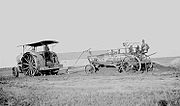
grader 1918Graders have been use for a long time in helping construction workers and engineers to build and improve communities. They are useful tools.

Graders are typically used to refine the grading that is started by heavier equipment like bulldozers and scrapers. These vehicles are used for rough grading. Dirt and gravel roads have been built using graders since 1903 when two entrepreneurs built the first Russell grader. Not long after that, commercial manufacturers like Caterpillar and John Deere began to make them for mass production. Some communities in the north use graders to scrape snow off of roads for safer travel. Even many farmers and ranchers all over the world use them to do farm work that is essential for their own maintenance needs.

The image above is a grader from 1918, borrowed from Wikipedia.

Grading is a common practice today in construction and engineering and with the help of ATS Heavy Equipment School, persons interested in learning a trade can learn to use a grader as well as other common heavy equipment.

Read more

Let’s Do The Safety Dance

One of the most important aspects of operating heavy equipment is safety. Your own safety as well as the safety of others. Heavy equipment operators need to have situational awareness at all times. Your safety, the safety of your fellow employees, and the safety of the general public are all equal concerns. One slip up and you could cost thousands of lives.

Heavy equipment operators can perform all kinds of feats in all kinds of situations. Not every job will be a super dangerous mission. But there are jobs that you will attempt with your heavy equipment that border on dangerous and keeping safety in mind while you operate is an essential choice.

ATS Heavy Equipment School offers courses on equipment safety to give operators an overview of the dangers involved in heavy equipment operation and to help you make long-term decisions for your own welfare as well as the welfare of others. When you take an ATS course in heavy equipment operation safety, you can bet that you have the latest and the best information that will make you a better operator and keep the work place safe for a long time.

Read more

What Does “National Certification” Mean?

If you want to operate heavy machinery in the U.S. then you should seek national certification. It will help boost your career in so many ways.

The National Center for Construction Education and Research (NCCER) was set up specifically to provide heavy machinery operators a way to get certified on the equipment they operate daily. Due to a shortage in heavy machinery operators and no standardized way to test the ones who are working, a need developed to maintain a standard operating practice that would let employers know they have the best skilled workers on their crew. That’s where national certification came in. Today, the leading construction companies in the world recognize NCCER and ATS is at the forefront of providing safe heavy equipment training.

All ATS schools are accredited by NCCER. That means when you get your diploma from the ATS Heavy Equipment Training School, you are qualified to work anywhere that heavy machinery is in operation. No one can question your skills.

Founded in 1995, NCCER is a not-for-profit agency. When you graduate from an ATS school, you’ll be qualified to work on any equipment any where. It doesn’t matter where you went to school. Your skills will be known as first among the class. And the National Registry of graduates qualified on heavy equipment will be available to employers so that your skills and background can be checked, making it easier for you to get the job you want.

If being a heavy equipment operator is in your future, you’ll want to be certified by the National Center for Construction Education and Research.

Read more

Heavy Equipment Training, Making the Most of your Opportunities

If you want to make the most out of your heavy equipment training then you need to put it to use straight away. This might involve some hard decisions, but is worth it in the end. If you are working somewhere where the opportunities to advance are limited, sometimes it is better to move on rather than wait for an opportunity to find your. Your heavy equipment training and certification is an enormous asset in the job market and will make finding your next job a relatively straightforward process.

Reasons to Change your Job

  • Not enough opportunities to put your training to use.
    This can be particularly frustrating and it will cause your skills to dull. What’s more, it is a waste of all of that effort that you put into honing your skills.
  • Not enough pay.
    If you are spending your time and money on training and your company is not upping the ante, find one that will. Do your research and find out what heavy equipment operators with your level of training are earning and find somewhere that will give you at least that.
  • Lack of Security
    If you see people fired for punitive reasons, or you feel that your company might be in financial trouble, you might be better off to find a company that holds onto its employees.
  • Poor opportunities for advancement.
    If your dreams for the future are bigger than your place of employment can offer, consider moving on.

With the training that you receive at Associated Training Services you can enjoy a competitive place in the workforce. There will be plenty of opportunities for you to find a job that puts your training; you don’t have to settle for second best.

Read more