
Bulldozer Grouser Bar: Get a Grip!

Bulldozers have a wide variety of tracks.

Except for the small ones you see in the city with rubber pads on their treads, they all rely on the shape of their tracks to keep them moving, to give them manueverability, and/or to give them flotation.

Assuming that you’re not working in a soft bog, the most important of these is probably traction, or the ability to keep going even when the blade is piled high with material. You can imagine how much force it takes to move tons of rock – it’s a tremendous amount, and sometimes the tracks just spin.

A good operator doesn’t let this happen to much, but a certain amount of it is inevitable. However, every time a track moves and the machine doesn’t, it means the track is rubbing across the ground. In hard rock, this can actually create enough heat to crack the rocks, and create smoke.

This will reduce wear in the dozer track, and if it’s not taken care of, the raised part of the tread will wear down smooth.

That’s where grouser bar comes in. Grouser tends to come in a vartiety of shapes and composiitions, but they all serve the same purpose: to build the track back up to where it can bite into the Earth again. It’s a tedious job, done by welders. It can be done on the machine, or when the tracks are taken off and laid out flat. Portable welding trucks can go right to the job site and have them done for you before the weekend shut-down is over.

Most times, it requires gouging out the previous grousers, and shaping the metal for the msot effective weld. Gouging is done with carbon rods and a lot of high-pressure air – it literally carves grooves in the metal by making it heating it, then blowing it out with a shaped blast of air.

The grouser bar is then stood up in this groove, and welded in with a rod that is more tough than it is hard. 7018 is the usual rod of choice, as it resists forces from all sides. That’s something that the grouser will face as the machine twists and turns over all sorts of rock.

While learning to run heavy equipment generally doesn’t teach you how to weld as well, it will give you enough knowledge about what’s required to keep your machine running well, and with enough traction that you can get the job done.
Read more

Hard Surfacing: What Is It, and Why do I Need It?

You’ve heard them before…, “Bulldozers, Graders, Excavators, Backhoes. Words like these conjure up images of toughness and invincibility…, of endurance and cold hard steel. Without seeing it for yourself, you wouldn’t guess that massive machines would wear away from moving a bit of dirt around. After all, these are the tools that we use to move mountains, dam rivers, and level hundreds of acres at a time, right?

All true, but moving large amounts of material doesn’t mean that there isn’t a cost. Given enough time, even hardened steel wears away. The abrasiveness of that material, whether it’s soft loam, loose sand, or hard rock, will determine the speed at which your blades, buckets, and rakers will erode, but erode they will. Sometimes at an alarming rate, and operation-killing costs.

The way this problem is solved: Before a blade, bucket, tooth, or other object is used for the first time, welders are brought in and they lay down beads of very hard welding rod. These rods are special alloys that contain metals like manganese, molybdenum, and chrome. Each manufacturer makes them with a range of properties, including:

  • Hardness (loamy soil only needs resistance to wear. but rocks require resistance to breakage AND wear)
  • Strikability from any angle (some rods flow better when welding upside down)
  • Penetration (or depth into the base metal)
  • Machinability (some hard surfacing needs to be machined, or shaped, after being laid down)
  • Slag Peeling (a cost-saving measure – the welding slag doesn’t have to be chipped afterward)
  • Pilability (some rods pile high, while others flow out flat against the base metal)

You may have seen hard surfacing before – it’s usually laid down in cross-hatch patterns. However, welding hundreds of yards of rod is tedious, so you sometimes see that more creative welders will make all sorts of patterns and designs, in order to keep their day from getting too boring. The point is to build up the hard surface on all areas that will contact the material and to have it thick enough that it takes the main force of whatever is being pushed, dug, or cut.

How often this needs to be re-done depends on the material being rubbed across the hard surfacing, and the amount of time spent playing in the dirt. In bad conditions, it may need to be done several times a season. One thing is certain though, if a contact surface isn’t hard surfaced, you’ll be buying a new blade, bucket, etc. before very much time has passed.

All of this can be learned at places like ATS Heavy Equipment Training Schools before you ever set foot on a job site.

Read more

Bulldozer Tracks: Keeping It Clean:

One of the more onorous jobs of running heavy equipment is keeping them clean. I’m not talking about taking it to the car wash or polishing it up in the driveway. I mean the cleaning that is required to keep the drive train from self-destructing.

It’s not all fun and games out there, folks. There are parts of this world where the dirt you move may turn into the dirt that stops you cold. Like thick Red River gumbo that squeezes into every cavity of your undercarriage, then freezes into something resembling concrete. Even what you thought was friendly loamy soil, coupled with a bit of moisture and a few degrees of frost, can mean the difference between working that day or spending hours and hours chipping away with a pick and shovel.

Conditions like that can turn even a D10 Cat into nothing more than a very large paper weight. That’s not a good thing. In order to avoid that, you need to plan the end of your day as well as you follow your lube procedures. If the crummy is heading down the mountain at five o’clock, then you need to have taken care of anything in your tracks that could stop you from getting going the next day, before it’s time to get on board.

Leave yourself enough time to dig out the mud, or whatever else is in the undercarriage. Anything near the drive train is usually warm enough after a day of running that it can be scraped off or dug out. Whatever is already frozen will still chip off. Believe me, it won’t be like that after a hard night’s freezing though.

When you’re sure there’s not enough crud left in the tracks that can things up, do your end-of-day lube (mor eon that in a later blog), and run the dozer’s tracks up on a fallen log. It makes a world of difference to have some air under a third or more of the track if there’s a hard freeze. Snowmobilers have the luxury of rocking their machines back and forth to break the track free. A Komatsu Komatsu D575A (largest dozer in the world!)…, not so much!

Read more

Learning to Run Heavy Equipment: It Ain’t Like It Used To Be (Part Two)

From the “How NOT to do it!” Department:

So after a freezing cold, thirteen hundred mile flight in an ancient DC3, I arrived in Echo Bay in the Northwest Territories, 12 miles south of the Arctic Circle. It was my twenty-fifth birthday, but I wasn’t celebrating. We landed on an ice strip – apparently right in front of the mine, but I couldn’t see anything but white. I have no idea how the pilot landed that thing. Two guys looked out the window and refused to leave the plane.

The rest of us newbies shuffled off the plane and onto a bus that took us up a winding goat trail to the office, where we were given a room, a list of rules, and were told to report to work within the hour. By the time I had put my stuff in one of the worst bunkhouses I’d ever seen, the weather closed in and the plane was grounded. For two days as it turned out.

Through near white-out conditions, I made my way down the 117 steps to the garage. After introductions the consisted of a nod, a grunt and a really bad cup of coffee, the foreman said, “Get on that six and put the blade on it. Push the road to the dump”, then he turned and left. I looked at the ancient mechanic, wondering what a six was. He tilted his head toward a bulldozer at the other end of the shop. A Komatsu D6. AHA…, I get it! Then to myself, “They want me to run that? I thought I was here for a forklift job?”

Then it sunk in…, I had never even sat on a bulldozer before, let alone had any training. I smiled a sickly grin. The old mechanic stared at me and spit on the floor. I smiled wider. He didn’t – he just stood there waiting for me to do something. So I gave him that time-honored line, “Huh! What d’ya know? She’s not quite like the last one I drove!” He rolled his eyes, sighed far too loudly, and pointed to the floorboards – he knew exactly what was going on. He’d probably seen hundreds of guys like me.

Humbled, I asked him where the blade was, and he pointed out into the now raging storm. “bout a hundre’…, up…,” I couldn’t hear him after that because he opened the big doors and walked out in the howling wind. Folks, here’s where I could really have used some training!

But at least I was alone! I climbed on my new “six”, and eventually found the starter – near the floorboards. I got lucky – it was an electric start, so that part went better than I deserved. Like I did on the sawmill forklift, I played with things until the machine lurched. After nearly stalling it a dozen times, I finally figured out what made it lurch in which direction, and backed out it out the door into the storm. Once I was clear of the building, I pulled the levers until it started to swing. It was the slowest turn ever made on a dozer – I had no idea if I was going to be able to stop swinging! I could just picture them finding me in the spring, frozen solid and still turning around in circles. I was so glad that no one could see me.

“Up” turned out to be fairly obvious – the place was built on a cliff. So I pointed the machine “up”, and trundled off into the blizzard. I had no idea where I was going, and within minutes, I couldn’t even see the buildings in the growing dark. “But…,”, I thought…, “But no one can see me, either!”

Several hours later, I was getting a bit better at making that monster go where I wanted it to, although I’m sure that I took years off the life cycle of those clutches. I still hadn’t found the blade, which is just as well – I had no idea how to mount it. They eventually sent a search party out for me. The foreman waved me back to the shop, and when I climbed down off ‘my’ six, he asked me, “Did you get it figured out?” “Oh yeah”, I said. He rolled his eyes and sighed way too loud. He knew.

So…, the long and the short of my story? Even if you have an “opportunity” like I that, don’t do what I did. Get some training. The machines will thank you.

Read more

It Ain’t Like It Used To Be: Part One

From the “How NOT to do it!” Department:

When I was young, it was a lot easier to get into running heavy equipment. On-the-job training was the usual way to learn, and even if you had a certificate, no one ever asked for it. As a result, there were “opportunities”, even if you had never seen the machine before!

My “opportunity” came when I was looking for a job in the Canadian North as a welder. My business had just gone under, and I was desperate for work. I found myself in Edmonton, Alberta…, in February. It wasn’t a great time to be looking for work – partly because the economy was bad, and partly because I was freezing my tail off as I slogged around to the various hiring halls.

After two very long weeks of searching, no one held out no promise for a welding job, but one personnel guy asked me if I’d ever ran a forklift. Of course, I said, “Oh yeah.” He said, “Well, you’d better have, because you’re going to be loading planes, and if you hit one of them, we’re both going to be looking for work!” I nodded wisely to show that I knew exactly what he was talking about.

Now…, I didn’t lie! He didn’t ask me if I knew how to run a forklift, and he never asked if I ever been trained – he only asked if I had ever run one.

I had…, on a sawmill job years earlier, when I needed a piece of plate steel for a conveyor I was welding up. The forklift was idling in the yard, forks in the air, and a perfect piece of plate was directly ahead of it about two hundred feet. The operator was no where to be found, so I jumped on board. After a few minutes of jamming gears and pulling levers, I got it to move. Did I mention that is not the way to learn?

I drove straight ahead, dropped the forks to the ground, and man-handled the steel onto them. For some reason, the forks wouldn’t go back up (??), so I found a chunk of rope, tied the steel to the frame, and dragged it back to my project.

Bad idea – I was written up by two unions: labour for moving a piece of lumber that was in my way, and operator’s for.., well, you know.

However, in that February morning in Edmonton, it allowed me to truthfully answer that man’s question, “Have you ever run a forklift?” I got the job, and two days later found myself on the shores of Great Bear Lake in the Northwest Territories, where it was REALLY cold! And where my lack of equipment training got me into even bigger trouble.

More on how not to learn to run heavy equipment later…,

Read more

History Of The Motor Grader

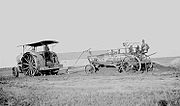
grader 1918Graders have been use for a long time in helping construction workers and engineers to build and improve communities. They are useful tools.

Graders are typically used to refine the grading that is started by heavier equipment like bulldozers and scrapers. These vehicles are used for rough grading. Dirt and gravel roads have been built using graders since 1903 when two entrepreneurs built the first Russell grader. Not long after that, commercial manufacturers like Caterpillar and John Deere began to make them for mass production. Some communities in the north use graders to scrape snow off of roads for safer travel. Even many farmers and ranchers all over the world use them to do farm work that is essential for their own maintenance needs.

The image above is a grader from 1918, borrowed from Wikipedia.

Grading is a common practice today in construction and engineering and with the help of ATS Heavy Equipment School, persons interested in learning a trade can learn to use a grader as well as other common heavy equipment.

Read more

Let’s Do The Safety Dance

One of the most important aspects of operating heavy equipment is safety. Your own safety as well as the safety of others. Heavy equipment operators need to have situational awareness at all times. Your safety, the safety of your fellow employees, and the safety of the general public are all equal concerns. One slip up and you could cost thousands of lives.

Heavy equipment operators can perform all kinds of feats in all kinds of situations. Not every job will be a super dangerous mission. But there are jobs that you will attempt with your heavy equipment that border on dangerous and keeping safety in mind while you operate is an essential choice.

ATS Heavy Equipment School offers courses on equipment safety to give operators an overview of the dangers involved in heavy equipment operation and to help you make long-term decisions for your own welfare as well as the welfare of others. When you take an ATS course in heavy equipment operation safety, you can bet that you have the latest and the best information that will make you a better operator and keep the work place safe for a long time.

Read more

Bulldozers Are For Girls Too

In the 21st century, you don’t have be a boy or drag your knuckles to want to play with dump trucks, bulldozers, and loaders. Girls can play too.

The ATS Heavy Equipment Training School has been known to certify female bulldozer and heavy equipment operators and it’s likely that we will continue to turn out the best equipment operators of either gender.

When it comes to training, you definitely want the best. And if you expect to excel in your career and have the best advancement opportunities then you want the best education. ATS schools are certified by by National Certification Programs that give heavy equipment operators a leg up everywhere. Our students are recognized as some of the best equipment operators in the world. Even our female operators do better in their careers because of the expert training they receive at ATS.

If you are serious about being a heavy equipment operator then try ATS.

Read more

Dump Trucks Bring Out The Boy In All Of Us

Little boys will usually take an interest in cars, trucks, and dirty things around the age of 3 or 4. By the age of 5 they are deeply entrenched in the art of manliness in the dirtiest of ways. They’ll play in the mud, get dirt on their knees, roll their Tonka toy dump trucks through the grass, and just feel swell about being a boy. And they never grow out of it.

Dump trucks are all the rage – at 5 and at 45. If you have a desire to be a dump truck operator then you should seriously look into a heavy equipment training course that can give you the background and certification you need to learn to drive a dump truck and operate other heavy machinery. The ATS Heavy Equipment Training School has the backing of a national creditation program that will give you the credibility you need to pursue a career as a dump truck driver. Why pass up this opportunity?

Not only can you learn to drive a dump truck through ATS, but you can also get your CDL and learn other heavy equipment too. Learn more about ATS Heavy Equipment School now.

Read more

What Does “National Certification” Mean?

If you want to operate heavy machinery in the U.S. then you should seek national certification. It will help boost your career in so many ways.

The National Center for Construction Education and Research (NCCER) was set up specifically to provide heavy machinery operators a way to get certified on the equipment they operate daily. Due to a shortage in heavy machinery operators and no standardized way to test the ones who are working, a need developed to maintain a standard operating practice that would let employers know they have the best skilled workers on their crew. That’s where national certification came in. Today, the leading construction companies in the world recognize NCCER and ATS is at the forefront of providing safe heavy equipment training.

All ATS schools are accredited by NCCER. That means when you get your diploma from the ATS Heavy Equipment Training School, you are qualified to work anywhere that heavy machinery is in operation. No one can question your skills.

Founded in 1995, NCCER is a not-for-profit agency. When you graduate from an ATS school, you’ll be qualified to work on any equipment any where. It doesn’t matter where you went to school. Your skills will be known as first among the class. And the National Registry of graduates qualified on heavy equipment will be available to employers so that your skills and background can be checked, making it easier for you to get the job you want.

If being a heavy equipment operator is in your future, you’ll want to be certified by the National Center for Construction Education and Research.

Read more